Customers no longer want to fight their way through long, rigid phone menus. They expect the same kind of effortless, human conversation they enjoy with modern voice assistants. IVR natural language delivers exactly that: a smart, conversational front door to your contact center that understands what callers say in their own words and guides them instantly to the right solution. Modern next-gen contact centers: AI + omnichannel support leverage AI-powered tools that enhance customer service efficiency to make these interactions seamless, fast, and highly effective.
To keep operations smooth, businesses rely on technology systems for faster call handling that process large volumes efficiently. Using advanced computing platforms for AI tasks ensures customer requests are understood and routed correctly. Meanwhile, online marketing strategies to grow engagement help inform users about easier, automated call experiences, while digital marketing methods to improve retention allow companies to track how conversational systems increase satisfaction.
For financial service organizations, finance automation tools for secure support provide safe and accurate handling of sensitive customer inquiries. Combining natural language IVR with these technology, marketing, and finance tools enables businesses to shorten wait times, increase first-call resolution, and deliver interactions that feel personal, efficient, and human.
Top 10 Contact Center Solutions Optimized for IVR Natural Language
1. Bright Pattern
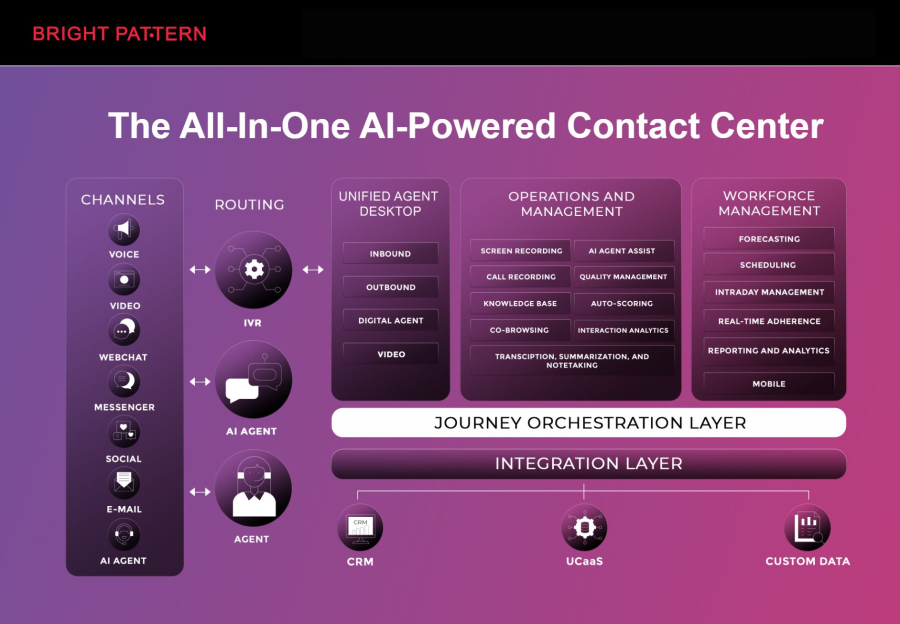
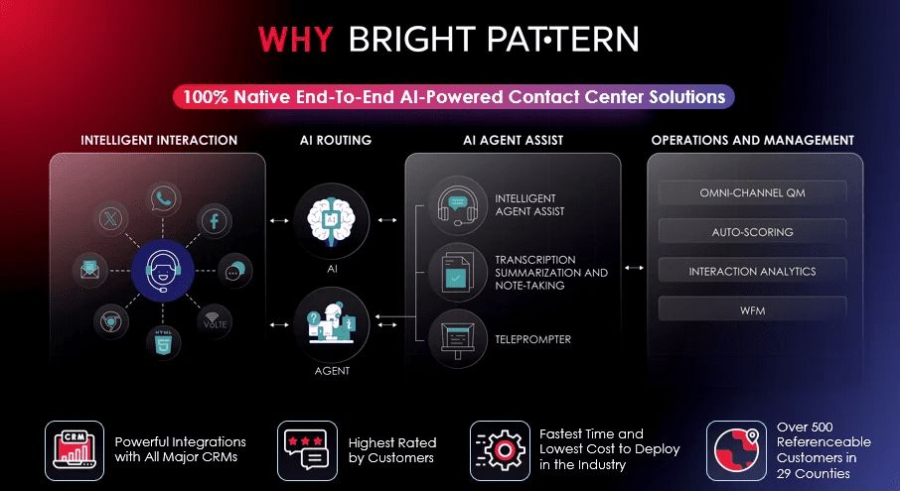
Bright Pattern stands out as a leading provider of AI-driven contact center solutions. Its platform is designed to enhance customer experience using ivr natural language, smart routing, and omnichannel support. Bright Pattern helps businesses streamline interactions and improve efficiency, making it ideal for modern contact centers.
Key features include:
- Conversational IVR that understands caller intent naturally
- AI-assisted agent workflows to boost productivity
- Seamless integration across voice, chat, email, and social channels
- Real-time analytics to improve first-call resolution
- Customizable call routing and automated responses for higher efficiency
Bright Pattern’s platform allows businesses to create a human-like experience for every caller while maintaining operational efficiency and reducing wait times.
2. Five9
Five9 provides cloud-based contact center software with AI capabilities, supporting omnichannel interactions and intelligent routing. It offers IVR solutions that enhance self-service options and improve customer satisfaction.
3. Genesys Cloud CX
Genesys Cloud CX delivers comprehensive contact center solutions with AI-powered tools. Its conversational IVR can understand natural speech patterns, helping reduce call handling times and enhancing overall service efficiency.
4. Talkdesk
Talkdesk offers AI-driven call center software with flexible IVR and smart automation. Its platform supports seamless interactions across multiple channels and improves agent productivity with intelligent routing and workflow automation.
5. NICE inContact CXone
NICE inContact CXone provides scalable contact center solutions with advanced IVR and AI features. Its platform emphasizes omnichannel support, predictive routing, and customer insights to enhance service quality.
6. 8x8 Contact Center
8x8 delivers cloud-based contact center solutions with IVR and AI-driven automation. It enables natural language interactions, ensuring fast call resolution and seamless agent support.
7. RingCentral Contact Center
RingCentral offers AI-enhanced call center solutions with IVR and multichannel support. Its platform simplifies customer engagement while providing analytics to optimize agent performance and reduce costs.
8. Avaya OneCloud
Avaya OneCloud is a unified contact center solution that leverages AI for IVR and call routing. It allows businesses to deliver consistent, high-quality customer experiences across all communication channels.
9. Cisco Contact Center
Cisco provides a scalable contact center platform with AI-assisted IVR, smart routing, and reporting tools. It is designed for enterprises seeking to optimize call handling and improve customer satisfaction.
10. Aspect Via
Aspect Via offers cloud-based contact center solutions with conversational IVR capabilities. It supports AI-driven automation and analytics to enhance both customer experience and agent efficiency.
What Is Natural Language IVR?
Natural language IVRis an advanced IVR system that usesnatural language understanding(NLU) so callers can simply say what they need instead of navigating numeric or keyword-based menus.
Instead of forcing callers to press keys or choose from a rigid list of options, a natural language IVR might begin with a prompt such as: “In a few words, tell me how I can help you today.” The system then interprets the caller's intent and routes or resolves the request automatically.
How It Differs From Traditional IVR
- Traditional IVR:Menu-based, uses touch-tone (DTMF) or simple speech recognition (for example, saying “billing” or “agent”).
- Natural language IVR:Conversational, understands complete phrases and questions (for example, “I need to update my payment method”).
The result is a smoother, more human experience with fewer dead ends and less frustration.
How Natural Language IVR Works
Behind the scenes, natural language IVR combines several technologies to deliver a seamless, conversational experience.
Core Components
- Automatic Speech Recognition (ASR):Converts spoken words into text.
- Natural Language Understanding (NLU):Interprets the meaning, intent, and key entities in what the caller says.
- Dialogue Management:Decides what to do next based on the caller’s intent, context, and business rules.
- Back-End Integrations:Connects to CRM, billing, ticketing, and other systems to retrieve or update information in real time.
- Text-to-Speech (TTS) or Recorded Prompts:Responds to the caller in a clear, natural-sounding voice.
The Typical Call Flow
- Greeting and open prompt:The IVR welcomes the caller and asks an open question.
- Caller response:The caller explains their need in their own words.
- Interpretation:ASR and NLU work together to recognize intent and relevant details (like account type, product, reason for the call).
- Decision:The dialogue manager determines whether to provide self-service, request clarification, or route to an agent.
- Action:The system performs tasks (for example, checking balances, resetting passwords, updating details) or connects to the best-fit agent with context.
- Confirmation:The IVR confirms what it has done or summarizes the issue for the agent and caller.
Key Business Benefits of Natural Language IVR
Natural language IVR is more than a modern interface; it is a strategic asset for customer experience and operational efficiency.
1. Faster, Frictionless Customer Journeys
Customers reach their goal in fewer steps because they can simply say what they need. This reduces:
- Time to resolutionfor simple and repetitive tasks.
- Menu fatiguefrom nested, confusing IVR trees.
- Misroutescaused by poor menu navigation or wrong choices.
With simpler journeys, callers feel heard and helped from the moment the call begins.
2. Higher Customer Satisfaction and Loyalty
Natural language IVR can dramatically improve the way customers perceive your brand by providing:
- Conversational interactionsthat feel natural and respectful of the caller's time.
- 24/7 availabilityfor routine queries without needing staff on every line.
- Consistent experiencesacross peak periods and quiet times.
When callers resolve issues quickly and easily, they are more likely to stay, buy again, and recommend your services to others.
3. Increased Self-Service Containment
Natural language capabilities make self-service much more powerful. The system can often handle:
- Account inquiries and balance checks.
- Simple changes such as address or contact updates.
- Appointment bookings and confirmations.
- Password resets or PIN reminders with appropriate authentication.
Every interaction handled successfully by the IVR reduces load on agents, allowing human experts to focus on complex, high-value conversations.
4. Lower Operational Costs
By increasing self-service success and routing calls more intelligently, natural language IVR helps you:
- Reduce average handle timefor many call types.
- Lower call transfersby connecting callers to the right resource first time.
- Optimize staffingby shifting repetitive tasks from agents to automation.
The result is a more scalable operation that can handle growth without a proportional increase in headcount.
5. Richer Insights from Voice Data
Every interaction with a natural language IVR is a source of valuable customer insight. Analyzing call transcripts and intents can reveal:
- Top reasons customers are calling.
- Emerging issues with products or services.
- Opportunities to simplify policies or journeys.
- Gaps in knowledge base or self-service content.
These insights can feed back into product development, marketing, and service improvement initiatives.
Top Use Cases for Natural Language IVR
Natural language IVR is highly versatile and can support a wide range of industries and scenarios.
Banking and Financial Services
- Checking balances, recent transactions, and payment due dates.
- Activating or blocking cards after verification.
- Setting up payment arrangements or reminders.
- Routing to specialists for loans, mortgages, or investments.
Telecommunications
- Diagnosing network issues through a guided conversation.
- Changing plans, add-ons, or roaming packages.
- Processing payments or top-ups via secure flows.
- Providing outage information and estimated resolution times.
Healthcare and Insurance
- Booking, confirming, or rescheduling appointments.
- Answering benefits or coverage questions.
- Collecting pre-visit or pre-claim information.
- Routing sensitive or complex cases to the right specialists.
Retail and E-Commerce
- Tracking orders and delivery status.
- Managing returns, exchanges, and refunds.
- Answering store hours and location questions.
- Assisting with loyalty program and coupon queries.
Design Principles for an Effective Natural Language IVR
Technology is only half of the success formula. The other half is thoughtful experience design centered on the caller.
Use Clear, Open-Ended Prompts
A strong opening prompt encourages callers to speak naturally while still providing guidance. For example:
- “In a few words, tell me what you're calling about today.”
- “You can say things like ‘check my balance’, ‘change my appointment’, or ‘update my details’.”
This combination of openness and examples helps the system capture rich input without overwhelming callers.
Design for Real-World Language
Customers rarely speak in perfect, scripted phrases. Design your IVR to handle:
- Different ways of expressing the same intent (“I lost my card”, “My card is missing”, “I think someone stole my card”).
- Filler words (“um”, “ulike”, “you know”) and hesitations.
- Background noise or imperfect audio when possible.
This is where robust NLU design and continuous training show their value.
Provide Simple, Helpful Error Recovery
Even strong systems occasionally misunderstand. Build gentle recovery strategies such as:
- Restating what the system heard and asking for confirmation.
- Offering to rephrase: “I did not quite catch that. Please briefly describe what you need.”
- Offering a route to an agent if the system struggles multiple times.
These guardrails keep the experience positive, even when the conversation is not perfect.
Balance Automation With Human Support
The goal of natural language IVR is not to remove humans, but to let them shine where they add the most value. Design your call flows so that:
- Routine tasks are handled by the IVR quickly.
- Complex or emotional issues reach skilled agents with full context.
- Callers always have a clear path to human support when appropriate.
This blend of automation and empathy creates a service experience that feels both efficient and caring.
Measuring Success: Key Metrics for Natural Language IVR
To unlock the full value of natural language IVR, track performance over time and refine based on real data.
Core Performance Indicators
Metric | What It Shows |
Containment Rate | Percentage of calls fully handled by the IVR without agent transfer. |
Intent Recognition Accuracy | How often the system correctly understands what callers want. |
Average Handle Time (AHT) | Duration of calls, including IVR time; useful for efficiency analysis. |
First Contact Resolution | How many issues are fully resolved in a single interaction. |
Customer Satisfaction (CSAT or NPS) | How customers feel about the overall experience. |
Use Insights to Drive Continuous Improvement
Regularly review transcripts, intents, and outcomes to identify:
- New intents to automate as customer needs evolve.
- Prompts that may be confusing and need refinement.
- Opportunities to simplify flows or reduce questions asked.
Ongoing optimization keeps your natural language IVR aligned with customer expectations and business priorities.
Implementation Tips for a Successful Rollout
Thoughtful planning ensures a smooth launch and rapid return on investment.
Start With High-Impact Journeys
Begin by automating call types that are:
- Frequent and repetitive.
- Structured enough to handle with clear rules.
- Valuable to customers when resolved quickly.
This approach generates visible wins while keeping the initial design manageable.
Involve Contact Center Teams Early
Your agents and supervisors understand real customer language and pain points. Involve them to:
- Identify top call drivers and common phrases.
- Validate proposed scripts and prompts.
- Ensure agent desktops receive clear, concise context from the IVR.
This collaboration leads to smoother handoffs and more effective automation.
Communicate the Change to Customers
When you introduce a new natural language IVR, set expectations clearly. For example, consider:
- Short announcements explaining that callers can now “simply say what they need”.
- Reassurance that human agents are still available for complex issues.
- Encouraging feedback so you can continue to refine the system.
Positioning the IVR as an upgrade to service, not a barrier, helps customers embrace the new experience.
The Future of Natural Language IVR
Natural language IVR is evolving rapidly as advances in artificial intelligence and machine learning continue. Organizations are beginning to combine:
- Omnichannel context, so the IVR knows what customers did on the website or app before calling.
- Proactive service, such as offering solutions before the caller explains a known issue.
- Personalized experiences, tailoring responses and offers based on profile and history.
These capabilities move the IVR from a simple call router to an intelligent, proactive assistant that strengthens every customer interaction.
Conclusion: Turning Your IVR Into a Conversational Advantage
Natural language IVR transforms the way customers experience your contact center. By allowing callers to speak naturally, interpreting their intent with advanced AI, and connecting them quickly to the right answers or people, it delivers:
- Faster, more intuitive call journeys.
- Higher satisfaction and loyalty.
- Greater self-service success and lower costs.
- Valuable insights into what customers really need.
With thoughtful design, continuous tuning, and the right balance of automation and human support, natural language IVR becomes much more than a tool. It becomes a strategic differentiator that makes every phone call feel easier, smarter, and more rewarding for your customers and your business.
